How to Plan an Edible Oil Production Line: Equipment Configuration from Oilseeds to Refining
2026-08-10
Qi'e Grain and Oil Machinery Co., Ltd.
Method Summary
Qi'e Grain and Oil Machinery explains how to plan an edible oil production line, covering oilseed selection, pretreatment, pressing or solvent extraction, crude oil handling, refining, capacity planning, and automation requirements.
Edible Oil Processing Project Guidance
Planning an edible oil production line begins with understanding the oilseed, the intended product standard, and the required production capacity. A connected line is not simply a collection of machines: each stage must be matched so that material flow, oil quality control, energy use, maintenance access, and future operating requirements can be considered together. Qi'e Grain and Oil Machinery Co., Ltd. supports oilseed processing businesses with equipment and process planning for pressing, extraction, crude oil handling, and edible oil refining projects.
Start with the raw material and target oil product
The physical and chemical characteristics of the selected oilseed influence nearly every equipment decision. Soybeans, sunflower seeds, palm kernels, rapeseed, peanuts, and other oil-bearing materials differ in oil content, moisture, hull proportion, particle size, storage behavior, and processing conditions. Before defining a line configuration, project teams should clarify the raw material supply and the oil product they intend to produce.
Raw material profile
Identify the oilseed type, expected incoming condition, moisture range, impurity level, shell or hull content, and storage requirements.
Processing route
Determine whether mechanical pressing, solvent extraction, or a combined press-and-extraction route is appropriate for the planned operation.
Finished oil requirement
Define whether crude oil, filtered oil, cold-pressed oil, or refined edible oil is the required output, together with packaging and market expectations.
Build the line around connected process stages
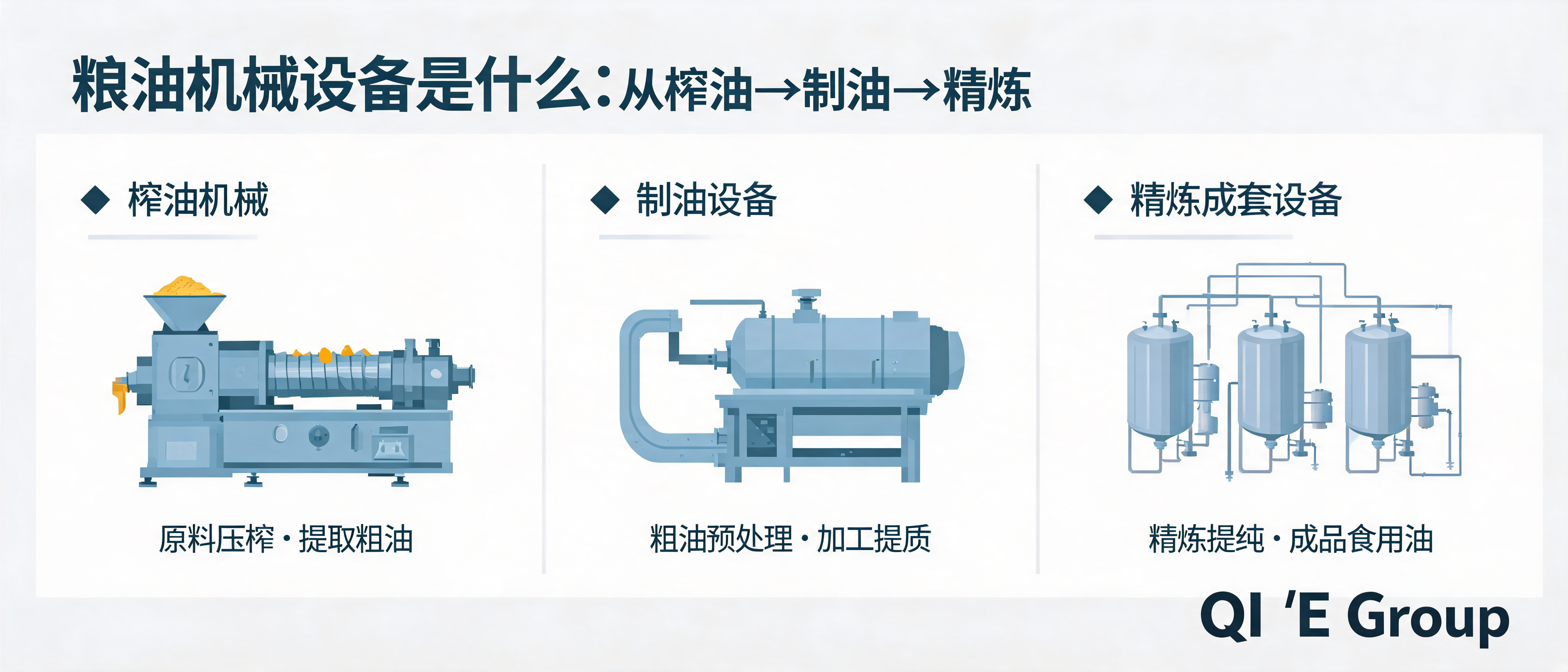
A typical edible oil production line can be arranged as a sequence of material preparation, oil recovery, crude oil treatment, and refining. The exact scope should be selected according to the oilseed, production route, plant capacity, and target product.
1. Receiving, cleaning, and preparation
The first section prepares oilseeds for stable downstream processing. Depending on the material, the preparation system may include conveying, screening, impurity removal, de-stoning, magnetic separation, drying, dehulling, cracking, flaking, cooking, or conditioning. Proper pretreatment helps create more consistent feed conditions for pressing or extraction.
2. Oil pressing or solvent extraction
Mechanical oil pressing is commonly selected where pressing is suited to the oilseed and project objective. For operations requiring a different oil recovery route, solvent extraction may be considered as part of the overall process design. In combined configurations, pressed cake can be evaluated as feed for a subsequent extraction stage. Equipment selection should account for feed preparation, material throughput, safe operating practices, and integration with upstream and downstream sections.
3. Crude oil handling and clarification
Oil from the recovery section generally requires controlled handling before refining or storage. The configuration may include settling, filtration, pumping, heating, and storage arrangements as appropriate to the process. This stage should be designed to support stable flow between oil recovery and the next treatment step.
4. Edible oil refining and finished oil preparation
Where refined edible oil is required, the refining section is planned around the characteristics of the crude oil and the intended product specification. Refining process arrangements may involve degumming, neutralization, bleaching, deodorization, filtration, and related handling systems. The refining scope should be reviewed together with utilities, storage, piping, and finished oil transfer requirements.
Equipment configuration checklist
The following framework helps project teams translate process requirements into an equipment selection list. Final configuration should be confirmed according to the selected oilseed, site conditions, capacity target, utilities, and applicable operating requirements.
| Process area |
Planning focus |
Typical equipment scope |
| Oilseed receiving and pretreatment |
Raw material cleanliness, moisture, hull content, particle preparation, and feed consistency |
Conveying, cleaning, separation, dehulling, cracking, flaking, cooking, and conditioning equipment |
| Oil recovery |
Selected recovery route, feed condition, material flow, and interface with cake or meal handling |
Oil pressing equipment, solvent extraction equipment, pumps, conveyors, and associated handling systems |
| Crude oil treatment |
Oil transfer, solids handling, temperature management, and intermediate storage |
Tanks, filters, pumps, heaters, piping, and control components |
| Refining section |
Crude oil characteristics, target edible oil quality, process sequence, and utility coordination |
Edible oil refining equipment, filtration, storage, transfer, and related systems |
| Automation and controls |
Operating visibility, coordinated sequencing, monitoring needs, and practical maintenance access |
Control panels, instrumentation, monitoring points, and automation interfaces selected for the project scope |
Match capacity across the full line
Capacity planning should not be limited to the rated output of one primary machine. Each connected section needs to support the planned material flow, including pretreatment, oil recovery, oil handling, refining, and storage. A practical plan also considers operating hours, raw material availability, cleaning and maintenance intervals, and the relationship between continuous and batch processes.
When one section is undersized or poorly connected, it can constrain the wider production line. Reviewing the process as an integrated system helps reduce avoidable coordination issues during equipment selection and installation planning.
Utilities and site conditions matter
- Available electrical supply and distribution arrangement
- Steam, heating, water, cooling, and ventilation needs where applicable
- Plant layout, foundation conditions, material access, and maintenance space
- Crude oil, finished oil, meal, cake, and by-product storage planning
- Applicable safety, environmental, and local compliance requirements
Choose an automation approach that fits the operation
Automation requirements vary by project size, process complexity, staffing model, and operator workflow. A well-planned control approach can support coordinated process operation and clearer equipment status visibility without introducing unnecessary complexity. The right level of automation should be determined by the actual operating needs of the line.
Planning note: Define key operating points before finalizing the equipment list. These may include material feed rate, temperature, pressure, liquid level, flow, and motor operating status, depending on the selected process. Clear control boundaries make it easier to coordinate individual machines as one production system.
Prepare clear inputs for equipment planning
A more useful equipment proposal begins with a well-defined project brief. Providing the following information allows the process route and equipment configuration to be evaluated more accurately:
- Oilseed type or intended range of oilseeds
- Target processing capacity and planned operating schedule
- Required output: crude oil, filtered oil, cold-pressed oil, or refined edible oil
- Available plant area, utility conditions, and local installation considerations
- Expected scope for storage, packaging, by-product handling, and automation
Plan with the complete process in view
From oilseed pretreatment and oil pressing to solvent extraction and edible oil refining equipment, an effective production line depends on process continuity and equipment compatibility. Qi'e Grain and Oil Machinery Co., Ltd. provides oil production line equipment and related technical support for businesses seeking a practical, project-specific configuration. A clear understanding of raw materials, capacity, product goals, and site conditions is the foundation for selecting the right line scope.